Inexco - CMX Active Melt Cooling
Active Melt Cooling. Intensive Mixing. One System.
The CMX Active Melt Cooler combines intensive melt homogenization with active melt cooling in a compact, modular system.
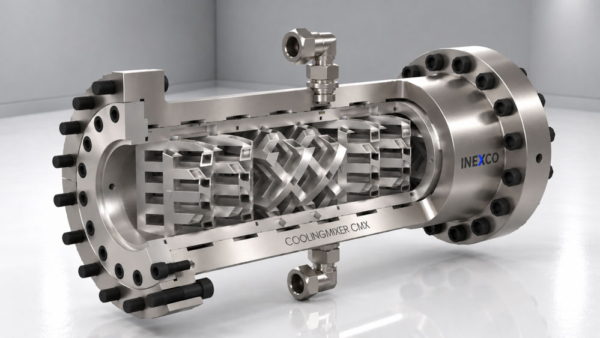
Conventional static mixers are primarily used to improve melt homogeneity. The CMX goes one step further by adding a critical process function: controlled heat removal directly from the polymer melt.
Its specially engineered flow geometry continuously splits, redistributes, and recombines the melt stream, creating intensive mixing and high overall heat transfer coefficients.
The result is efficient melt homogenization and heat transfer combined in a single process component.
Greater Control Over Melt Temperature
As extrusion rates increase, higher mechanical energy input and viscous heat generation can raise the melt temperature. In many extrusion processes, excessive melt temperature can become a limiting factor for throughput, process stability, and product quality.
This is where the CMX provides a decisive advantage: by actively removing heat from the melt, it allows the melt temperature to be precisely controlled and the thermal condition of the melt to be optimized before it enters the downstream extrusion die or subsequent process stage.
This provides greater control over the thermal load of the extrusion process and creates more stable melt conditions at the die inlet.
Key Key Benefits
- Active heat removal directly from the polymer melt
- Intensive, continuous melt homogenization
- Precise control of melt temperature
- Wider processing window with the potential for increased extrusion rates
- Modular configuration to suit different process requirements
- Compact integration into new and existing extrusion lines
- Suitable for retrofit applications replacing or upgrading existing static mixers
Why Use a Melt Cooling?
-
Modern extrusion processes are increasingly designed for higher throughput and maximum line productivity. As screw speed and mass throughput increase, more mechanical energy is transferred into the polymer melt. Part of this energy is converted into heat through shear and viscous dissipation.
As a result, melt temperature can continue to rise even when barrel temperature setpoints have already been reduced. Depending on the polymer and extrusion process, excessive or non-uniform melt temperatures can lead to longer downstream cooling requirements, reduced dimensional stability, increased thermal stress on the material, and ultimately a limit on economically achievable throughput.
-
Static mixers are highly effective at splitting, redistributing, and homogenizing the polymer melt. Their primary function, however, is melt homogenization. Without dedicated temperature-controlled heat transfer surfaces, they cannot actively and precisely remove heat from the melt.
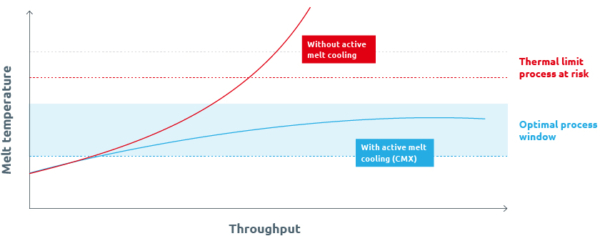
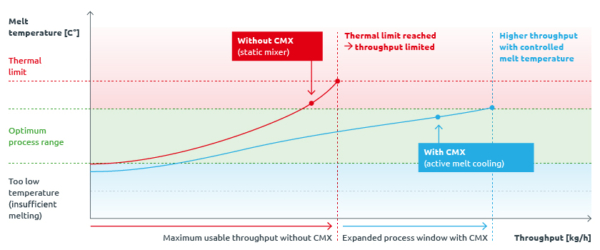
Throughput vs. Melt Temperature
Active melt cooling helps maintain the melt temperature within a controlled operating range, providing the potential for:
- Higher extrusion rates
- Consistent product quality
- Improved process stability
- A wider and more robust processing window
Active melt cooling adds another degree of freedom to extrusion process control. Rather than allowing melt temperature to become the limiting factor at higher output rates, heat can be actively removed to maintain more favorable thermal conditions as throughput increases.
How the CMX Works
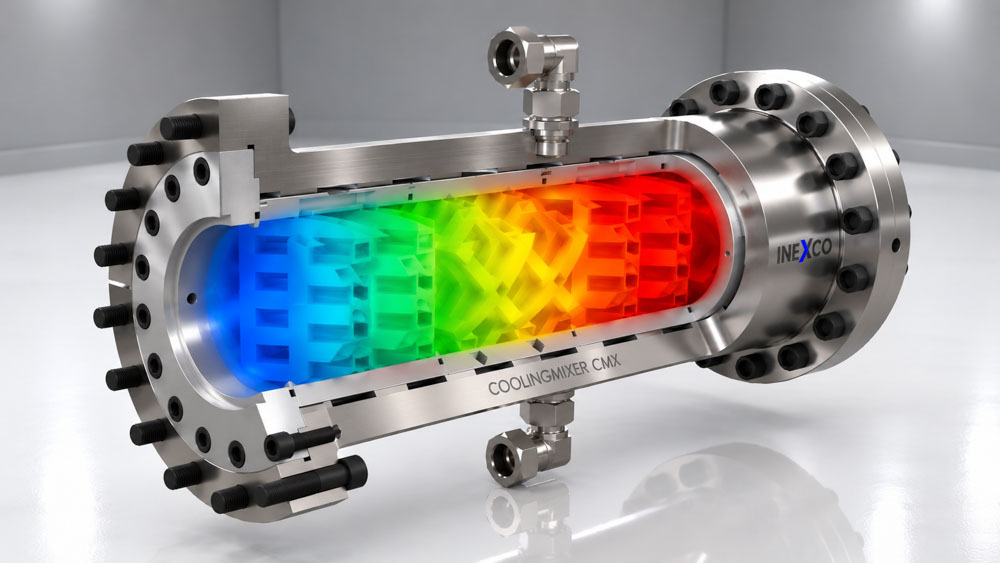
The CMX combines intensive melt homogenization and active heat removal in a single process stage. Rather than simply passing through the unit, the polymer melt is systematically redirected, repeatedly split, and redistributed. This continuously exposes fresh melt layers to the temperature-controlled heat transfer surfaces of the CMX, promoting efficient heat removal throughout the melt stream.
The operating principle is based on three key mechanisms:
-
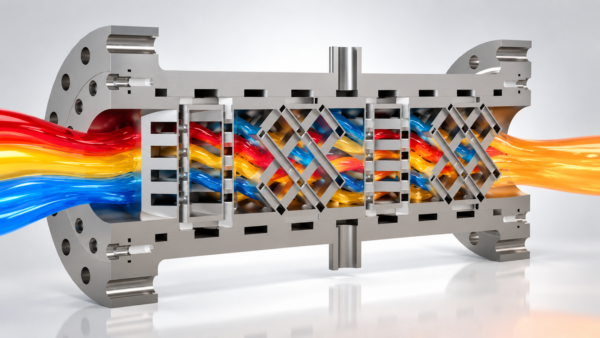
1. Melt Homogenization
The specially designed mixing elements continuously split, redistribute, and recombine the melt stream, reducing temperature and concentration gradients across the flow.
This creates more uniform melt conditions at the die inlet, helping to stabilize melt flow and reduce process variations that can affect the final extrudate.
The result: more consistent die inlet conditions, improved process stability, and more uniform product quality. -
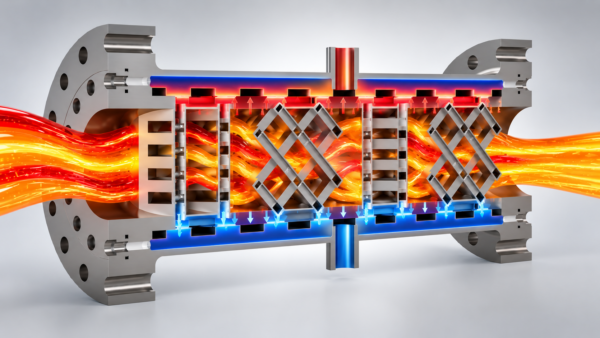
2. Heat Transfer
Intensive melt redistribution continuously brings fresh melt layers into contact with the temperature-controlled heat transfer surfaces, while moving hotter material from the core of the melt stream toward these surfaces.
This addresses one of the key challenges in cooling highly viscous polymer melts: efficiently transferring heat from the melt core to the cooled surfaces, where it can be removed from the process. -
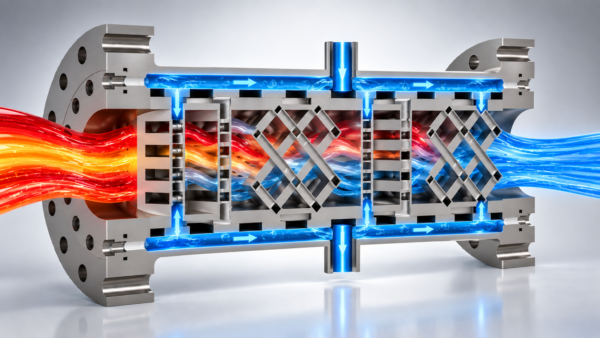
3. Active Melt Cooling
A temperature-controlled heat transfer fluid removes heat from the polymer melt at a controlled rate. This extends the CMX beyond the function of a conventional static mixer:
Melt Homogenization + Heat Transfer + Active Melt Cooling
The objective is not to achieve the lowest possible melt temperature, but to bring the melt to the optimum processing temperature for the specific extrusion application. This provides precise control of the melt temperature entering the die and helps maintain a stable processing window, even at higher extrusion rates.
Expanding the Processing Window
The CMX adds an additional degree of freedom to extrusion process control. By actively removing heat from the polymer melt, it can offset part of the additional thermal load generated at higher extrusion rates and help keep melt temperature within the desired operating range.
This can extend the usable processing window toward higher throughput, provided that cooling capacity, pressure drop, and other relevant process limits remain within acceptable ranges.
More Throughput Potential. Controlled Melt Temperature. Greater Usable Process Capacity.
From Energy Input to Controlled Melt Temperature
The CMX operates downstream of the plasticizing section, where it actively removes excess heat from the polymer melt while providing intensive melt homogenization.
This adds active thermal control to the melt stream, allowing the melt condition to be precisely adjusted before it reaches the downstream die or process stage.
Engineering & CFD
Engineered for Your Extrusion Process
The performance of a melt cooler depends on how precisely it is matched to the specific extrusion process. The CMX is therefore not treated as an off-the-shelf component, but engineered around the requirements of each individual application.
The design is based on the relevant process and material data, including polymer type, throughput, melt inlet temperature, target outlet temperature, operating pressure, and installation conditions. If not all required data is available at the start of a project, INEXCO supports customers in determining the necessary process parameters.
CFD-Based Engineering
CFD simulations are used during the engineering phase to evaluate melt flow distribution, thermal performance, and pressure drop. This makes it possible to assess the interaction between flow geometry, heat transfer, melt homogenization, and pressure loss before the system is manufactured.
The objective is not maximum cooling capacity, but a controlled melt temperature combined with good melt homogeneity and an acceptable pressure drop.
Key design parameters include:
- Melt flow distribution and homogenization
- Temperature distribution and heat transfer
- Pressure drop and available pressure margin
- Throughput and residence time
- Number and configuration of mixing/cooling elements
- Integration into the existing extrusion line
The process does not have to adapt to the CMX – the CMX is engineered to match the process.
The process data and CFD results are used to define the final CMX configuration. System size, number of mixing/cooling elements, flow geometry, and cooling capacity are matched to the specific extrusion application.
The modular design provides an additional advantage: if process requirements change later, the mixing and cooling section can be reconfigured and, where the system design allows, extended with additional mixing/cooling elements and corresponding housing sections.
INEXCO supports the entire project:
- Understand the extrusion process
- Define the required process data
- Perform CFD analysis
- Size and configure the CMX
- Engineer and manufacture the system
- Integrate and commission the CMX
The result is more than a melt cooler: a process component engineered specifically around the thermal and rheological requirements of the extrusion process.
The process does not have to adapt to the CMX. The CMX is engineered to match the process.
CFD Simulation
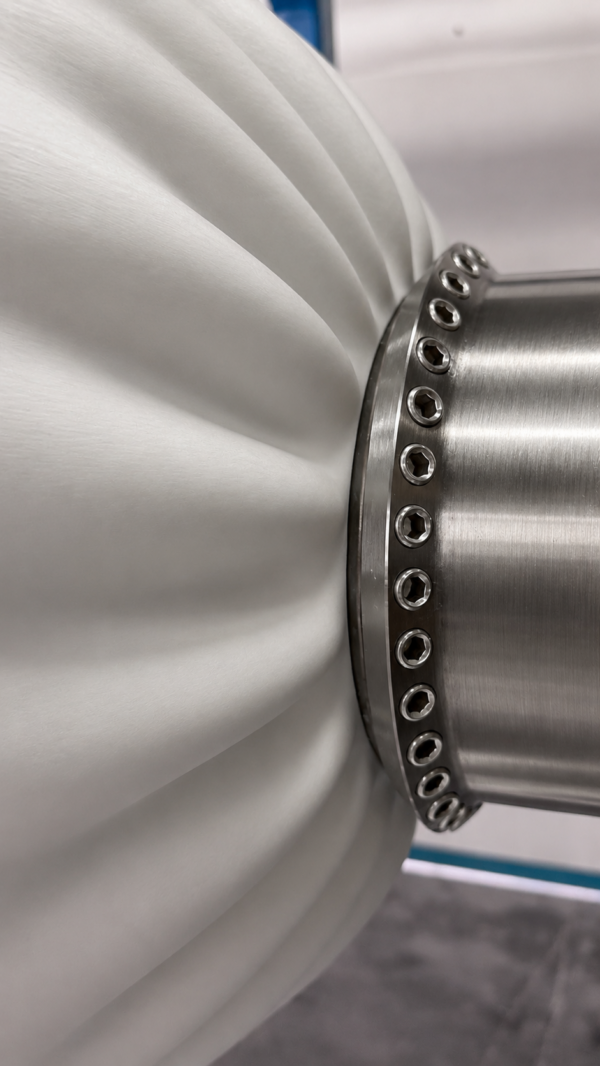
CFD simulation shows how the polymer melt is continuously split, redistributed, and directed toward the heat transfer surfaces inside the CMX. At the same time, temperature distribution, melt flow behavior, and pressure drop can be analyzed and evaluated during the design phase.
Simulate. Understand. Engineer with Precision.
A System That Grows with Your Process
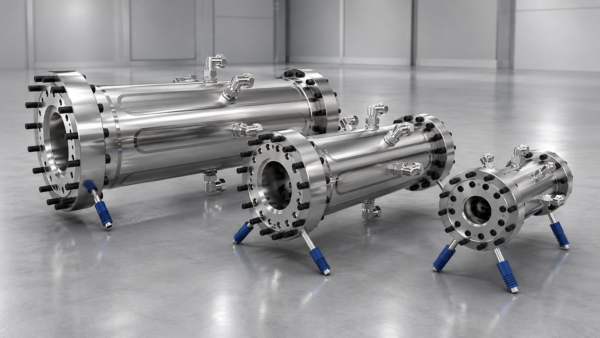
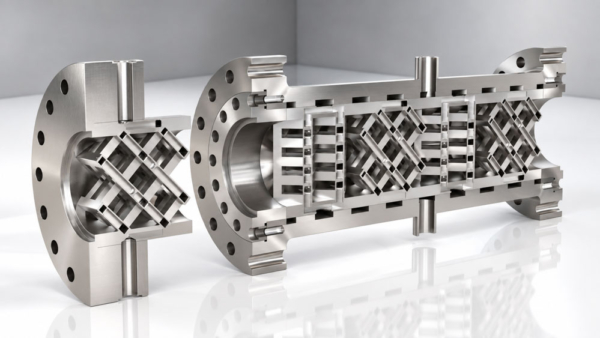
The CMX is designed as a fully modular system. The number and configuration of mixing/cooling modules can be matched to the polymer, throughput, inlet melt temperature, and required cooling duty.
A key advantage is its ability to be expanded as process requirements change. Depending on the original system configuration, additional mixing/cooling modules and corresponding housing sections can be added. The individual modules integrate seamlessly to form a continuous mixing and cooling section.
This allows the CMX configuration to be adapted to changing production requirements – for example, higher extrusion rates, different polymer formulations, or increased cooling demand.
Engineered for today. Expandable for tomorrow.
Scalability
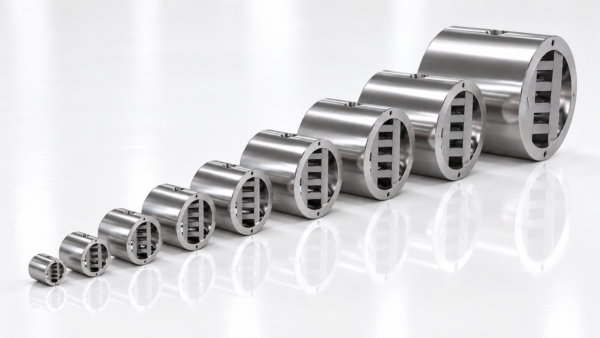
The CMX can be scaled for a wide range of extrusion line sizes and throughput requirements. The fundamental operating principle – intensive melt homogenization, efficient heat transfer, and active melt cooling – remains the same across all system sizes.
Scaling, however, is not simply a matter of increasing dimensions. As the nominal diameter and throughput increase, the flow and heat-transfer conditions change. Each CMX size is therefore engineered specifically for its required process duty.
Key design parameters include polymer rheology, throughput, inlet and target melt temperatures, required cooling duty, pressure drop, residence time, and available installation space.
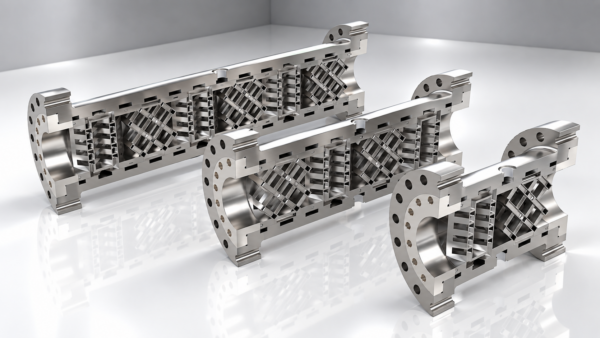
This allows the CMX concept to be applied from laboratory and pilot extrusion lines through to full-scale industrial production, with each system sized and configured for the required process capacity.
Available nominal sizes:
DN 40–50, 75, 100, 125, 140, 150, 175, 200, 250, 300, and 400.
Additional sizes available on request.
Same operating principle. Different capacities. Engineered for the process.
CMX for Your Extrusion Process
Every extrusion process has its own requirements for melt temperature, throughput, pressure drop, and cooling duty. That is why CMX engineering starts with your process – not with a standard system size.
Together, we evaluate the relevant process conditions, polymer properties, and thermal requirements to determine where active melt cooling can provide a measurable process benefit. Based on this analysis, we develop a CMX configuration tailored to your specific extrusion application.
From initial process assessment and system sizing through to integration into your extrusion line.
Want to know whether active melt cooling could increase throughput, improve melt temperature control, or expand the operating window of your extrusion process?