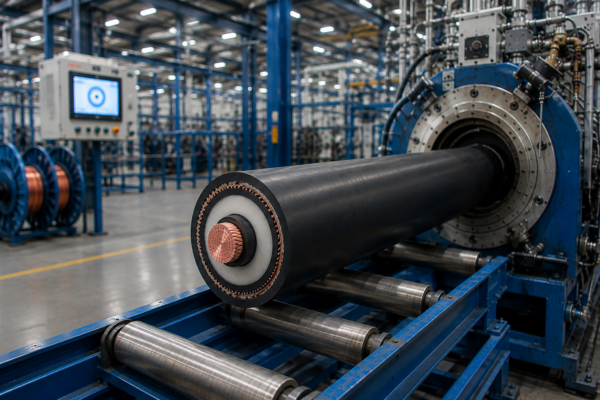
Inexco - XLPE Cable Extrusion
Challenges in XLPE Cable Extrusion
Processing XLPE compounds requires precise control of the thermal conditions throughout the extrusion process. Melt temperature, residence time, and material condition must remain within the processing window specified for the particular compound.
As production rates increase, higher mechanical energy input can increase the thermal load on the material. At the same time, maintaining a uniform and controlled melt temperature upstream of the die is important for stable processing.
CMX Approach
The CMX combines intensive melt homogenization with active, controlled heat removal. As the melt is continuously split and redistributed, excess heat can be transferred from the polymer through temperature-controlled heat transfer surfaces.
This provides an additional degree of thermal control upstream of the extrusion die, allowing the melt condition to be adjusted more precisely before forming.
Each CMX is engineered around the specific XLPE compound, throughput, thermal requirements, and permissible processing conditions.
Key Benefits
- Active and controlled heat removal from the polymer melt
- More uniform melt temperature distribution
- Additional thermal control upstream of the extrusion die
- Application-specific configuration for compound and throughput
- Compact integration into the melt flow path
- CFD-based engineering of melt flow and heat transfer
Controlled Melt Conditioning for Demanding Cable Extrusion Processes.