Inexco - PIPE EXTRUSION
Challenges in Pipe Extrusion
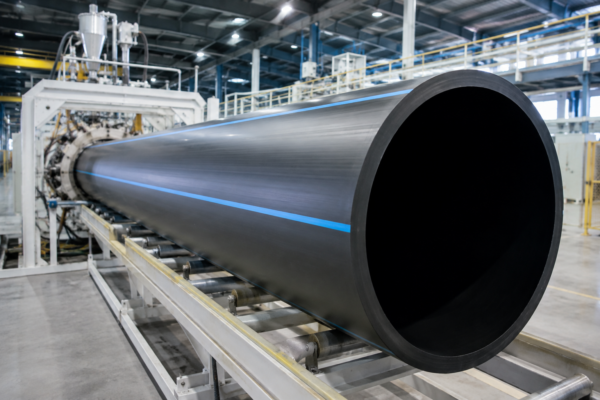
Sagging is a key challenge, particularly in large-diameter and thick-wall pipe extrusion. After leaving the die, the still-soft melt can deform under its own weight, resulting in an uneven wall thickness distribution.
A uniform, precisely controlled melt temperature helps establish a more consistent viscosity profile at the die inlet. By actively conditioning the melt before it enters the die, the CMX can support improved dimensional stability and a wider processing window with respect to sagging.
CMX Approach
The CMX actively removes heat from the polymer melt upstream of the extrusion die while simultaneously homogenizing the melt temperature profile.
Depending on the polymer, lowering the melt temperature increases melt viscosity. This can improve the ability of the extrudate to maintain its shape after leaving the die – particularly in large-diameter and thick-wall pipe extrusion, where the still-soft melt is more susceptible to gravitational sagging.
By combining active melt cooling with intensive thermal homogenization, the CMX provides greater control over the melt condition immediately upstream of the die. This creates additional process headroom for dimensional stability, sagging control, and increased throughput.
Key Benefits
- Active melt cooling upstream of the extrusion die
- More uniform melt temperature distribution
- Precise control of melt temperature
- Increased melt viscosity at reduced melt temperatures, depending on the polymer
- Improved dimensional stability after the die
- Potential to reduce sagging in thick-wall pipe extrusion
- Wider processing window
- Potential for higher extrusion rates
- Suitable for integration into existing lines as a retrofit solution
Control Melt Temperature. Improve Dimensional Stability. Expand the Processing Window.