Inexco - Foam Extrusion
Process Expertise for Stable Foam Extrusion
Foam extrusion requires precise interaction between polymer, blowing agent, temperature, pressure, melt conditioning, and extrusion tooling.
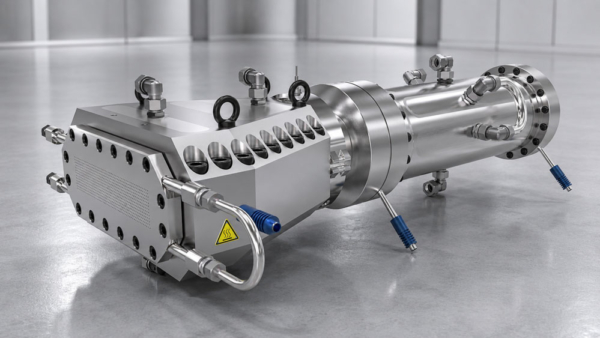
INEXCO combines extensive experience in foam extrusion with in-house extrusion die technology, active melt cooling, and application-specific engineering. Our capabilities range from annular dies for foam film and flat dies for foam sheet to custom-engineered dies for foam profile extrusion.
Rather than considering individual components in isolation, we look at the entire process – from extrusion and gas injection through homogenization and melt cooling to forming and expansion.
The objective is stable processing conditions, reproducible foam structures, consistent product quality, and efficient production performance.
Key Benefits
- Stable and repeatable foam extrusion processes
- Uniform cell structure and product quality
- Controlled melt temperature upstream of the extrusion die
- Wider usable processing window
- Potential for higher extrusion rates
- Application-specific process and tooling solutions
Understanding the Foam Extrusion Process
Foam extrusion is a precisely coordinated process involving polymer melting, gas injection, homogenization, melt cooling, and forming. A key requirement is maintaining defined thermal and flow conditions in the blowing-agent-loaded melt all the way to the extrusion die.
Precise coordination of blowing agent, melt temperature, melt flow, and extrusion tooling provides the foundation for a stable process and reproducible product quality.
- Polymer
Polymer pellets are fed into the extruder. - Extrusion
The polymer is melted and homogenized while the required process pressure is generated. - Gas Injection
The physical blowing agent is precisely metered and injected into the pressurized polymer melt. - Homogenization & Melt Cooling
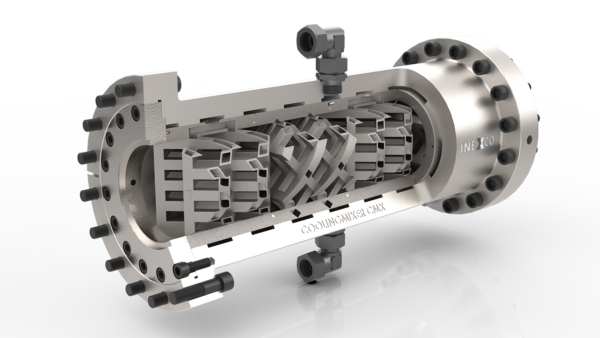
After gas injection, the blowing agent must be distributed as uniformly as possible throughout the polymer melt while the melt is conditioned to the temperature required for controlled foaming. The CMX Active Melt Cooler combines intensive homogenization and active heat removal in a single process stage. - Extrusion Die
Depending on the application, an annular die, flat die, or profile die is used. The extrusion die distributes and forms the conditioned melt for the required product geometry. - Expansion & Calibration
As pressure drops at the die exit, the melt expands. The resulting foam product is then formed, cooled, and stabilized. - Foam Product
The result is a foam product with defined density, cell structure, geometry, and surface quality.
Extrusion Dies for Foam Products
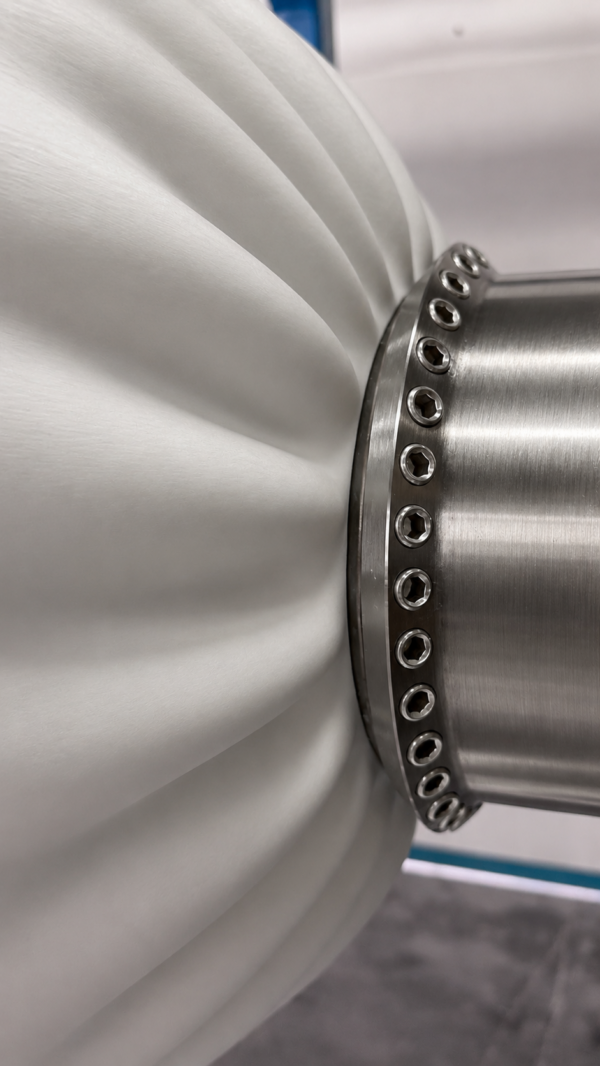
The extrusion die is the critical interface between the conditioned, blowing-agent-loaded polymer melt and the expanding foam product. Melt flow, pressure reduction, thermal conditions, and die exit geometry all influence expansion behavior, cell structure, surface quality, and final product geometry.
INEXCO develops and manufactures extrusion dies for a wide range of foam extrusion applications. Die geometry and configuration are engineered around the polymer, blowing agent, throughput, target foam density, and final product requirements.
This combines extrusion die engineering with in-depth process expertise – from melt conditioning through to the controlled forming of the foam product.
-
For foam film extrusion, INEXCO develops annular dies with precisely adjustable die gaps, flex lips, repeatable centering, and independently controlled cooling zones.
-
Flat dies are engineered around the required sheet width, thickness, throughput, and the specific flow and expansion conditions of the foam extrusion process.
-
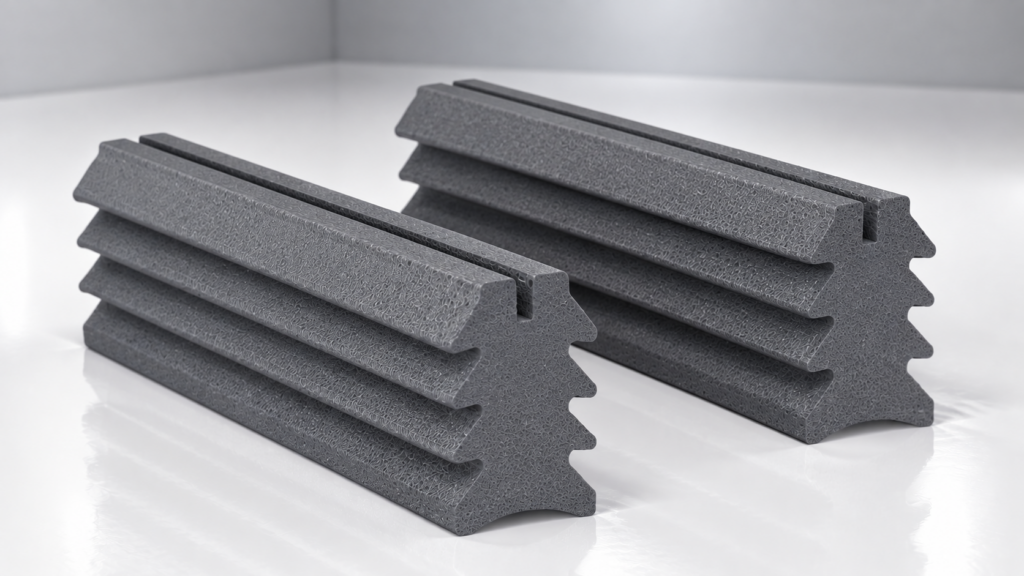
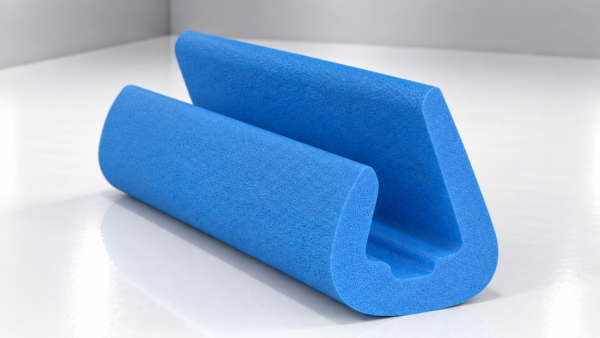
For foam profile extrusion, INEXCO combines extrusion tooling with comprehensive process expertise. Die design is specifically matched to the profile geometry, polymer, expansion behavior, calibration requirements, and required product properties.
Annular Die Technology for Controlled Foam Film Extrusion
The annular die determines the melt flow and exit conditions immediately before expansion of the blowing-agent-loaded polymer melt. Uniform circumferential melt distribution and precisely adjustable mechanical and thermal conditions are essential for maintaining a stable film profile.
INEXCO develops and manufactures annular dies whose geometry and size are engineered around the polymer, blowing agent, throughput, film thickness, and required product geometry.
-
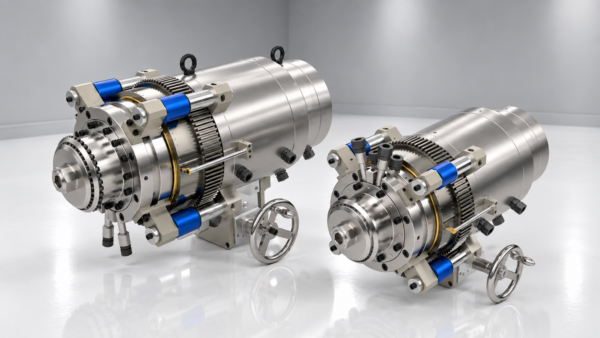
The annular gap between the inner and outer lips can be opened and closed with precision. This allows the basic setting for the film thickness to be specifically adjusted to suit the product and production conditions.
-
The nozzle lip is designed as a flexible lip. It allows local variations in the outlet gap to be finely adjusted, thereby specifically compensating for differences in thickness in the foam sheet.
-
The outer lip is centred relative to the inner lip by means of a precisely adjustable tilting movement of the outer lip. Once settings have been determined, they can be modified as required and reproduced consistently – an important advantage when dealing with recurring products and formulations.
-
The inner and outer lips have separate cooling zones. This allows the thermal conditions at the nozzle outlet to be controlled in a differentiated manner and specifically adapted to the respective foaming process.
CMX in Foam Extrusion
In foam extrusion, the temperature of the blowing-agent-loaded melt plays a critical role in determining the conditions under which expansion and cell formation take place. At the same time, increasing throughput can increase the thermal load on the extrusion process.
The CMX Active Melt Cooler combines intensive melt homogenization with active heat transfer. Heat can be actively removed from the polymer melt, allowing the melt temperature to be brought into the required processing range before it enters the extrusion die.
More Thermal Process Headroom for Higher Throughput
As extrusion output increases, additional mechanical energy can be introduced into the polymer melt. Without sufficient cooling capacity, this can increase melt temperature and restrict the usable processing window.
The CMX provides additional cooling capacity between the extruder and extrusion die. This can create additional thermal process headroom for increased throughput, provided that other process limitations – particularly pressure drop, extruder capacity, die performance, and product requirements – remain within acceptable ranges.
The result is a wider usable processing window with controlled melt conditions at the extrusion die inlet.
- Active, controlled melt cooling
- Intensive thermal and material homogenization
- Controlled melt temperature at the die inlet
- Wider usable processing window
- Potential for higher extrusion rates while maintaining stable product quality
Applications
Solutions for Different Foam Products
Melt conditioning and extrusion tooling requirements vary significantly depending on the foam product. INEXCO develops solutions for foam film, foam sheet, foam profiles, and other custom foam extrusion applications.
Polymer, blowing agent, foam density, throughput, melt temperature, and die geometry are considered as parts of an integrated process system.
Process Optimization & Engineering
Not every foam extrusion process requires an entirely new extrusion line. In many cases, significant optimization potential lies in the interaction between existing equipment and process parameters.
INEXCO analyzes existing production conditions, including polymer, blowing agent, temperature profile, pressure level, throughput, melt conditioning, and extrusion die conditions.
Based on this analysis, targeted measures can be developed to improve process stability, product quality, and production output.
Typical optimization objectives include:
- Improve cell structure
- Stabilize foam density
- Increase extrusion output
- Optimize temperature control
- Reduce process variations
-
Careful coordination of melt temperature, blowing agent, pressure, and die conditions can support the formation of fine, uniform, and stable cell structures.
-
Uniform melt conditions and controlled processing improve density distribution, dimensional stability, surface quality, and repeatability of the foam product.
-
Thermal and process-related limitations can restrict production capacity. By optimizing the extrusion process, available throughput potential can be utilized more effectively and overall productivity increased.
-
Targeted temperature control and a well-coordinated extrusion process help avoid unnecessary energy consumption and improve the overall energy efficiency of the production line.
-
A robust processing window reduces sensitivity to process variations and supports consistent product quality over extended production runs.